Add your promotional text...


Southern France - Transition Frontier at the heart of Europe
Some 30 km west of Nice, Sophia Antipolis is historically renowned for software, telecommunications, microelectronics, and AI, and its presence in the electrical storage, battery technology, and clean energy entrepreneurship space has grown significantly over recent years.This ecosystem relies on a combination of academic research, corporate R&D in power management chips, specialized incubators, and regional venture networks:
1. Academic & Scientific Research Infrastructure
MINES Paris PSL – PERSEE Center: The primary scientific anchor for energy research in Sophia Antipolis. The Centre Procédés, Énergies renouvelables et Systèmes Énergétiques (PERSEE) conducts research on:
Battery Management Systems (BMS) & Smart Grids: Modeling thermal and electrochemical dynamics, second-life battery integration, and hybridizing battery storage with hydrogen fuel cells.
System-Level Control: Algorithms for predictive energy management and grid balancing using stationary Battery Energy Storage Systems (BESS).
Université Côte d’Azur & CNRS (CRHEA / LEAT): Focus on advanced materials (such as Wide Bandgap semiconductors like Gallium Nitride and Silicon Carbide) that drive high-efficiency power electronics, inverters, and fast-charging interfaces for battery storage architectures.
2. Commercial R&D & Semiconductor Enablers
Sophia’s deep microelectronics heritage plays a critical role in the commercial battery storage chain:
Semiconductor & BMS Controllers: Companies like NXP Semiconductors, STMicroelectronics, and ARM maintain R&D teams focusing on low-power microcontrollers, battery cell monitoring chips, and automotive/industrial BMS architectures.
Automotive & EV Energy Systems: Renault Software Labs, Mercedes-Benz R&D, and tier-1 suppliers like Bertrandt design embedded software for EV battery telemetry, energy recuperation, and vehicle-to-grid (V2G) power transfer within Sophia.
3. Entrepreneurship, Startups & CleanTech Acceleration
Startup creation in the storage and energy transition space is supported by local incubators and financing networks:
Incubators & Acceleration Nodes:
PACA-Est Incubator & TechForward: Provide early-stage funding and incubation for DeepTech spin-outs from MINES Paris, INRIA, and EURECOM.
Capenergies Competitiveness Cluster: Operating across the Sud Region with a strong Sophia presence, this cluster supports startups in energy storage, microgrids, and decentralized power management.
Sophia-Born CleanTech & Energy Ventures:
HySiLabs: A prominent Sophia Antipolis startup success story in alternative energy storage, focusing on liquid hydrogen vector technology for safe transport and release.
Local Storage & Energy Integrators: Specialized SMEs like AMPERE focus on localized renewable integration, energy efficiency systems, and commercial battery storage setups.
Venture Capital & Business Angels: Sophia Business Angels (SBA) and regional venture capital funds (e.g., Région Sud Investissement) actively deploy seed and Series A funding into regional CleanTech, smart grid, and hardware-software energy management startups.
ITER - Paving the way to a Fusion filled future
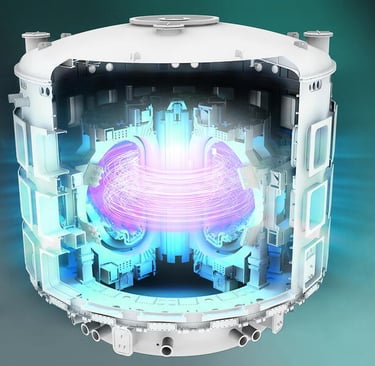
A little to the west of the Sophia-Antipolis Technology complex, in the Bouches-du-Rhône department of France, 34 countries are collaborating to build the largest tokamak ever designed—a machine intended to demonstrate that fusion (the energy of the Sun and stars) can serve as a large-scale, CO2-free source of electricity. The results of the ITER scientific program will be crucial in paving the way for the fusion power plants of the future. ITER's primary objective is to generate "burning plasmas" and to understand their behavior.
What is a tokamak? A tokamak is an experimental machine designed to harness fusion energy. Inside the tokamak, the energy generated by the fusion of atomic nuclei is absorbed as heat by the walls of the vacuum vessel. Much like conventional power plants, a fusion power plant uses this heat to produce steam and subsequently generate electricity via turbines and alternators.